Astronomy Answers
Great Circles
All pictures on this page are contributions by Dr. Bernd Frassek.
1. A Great Circle
Fig. 1: Drawing of a Great Circle on a Sphere
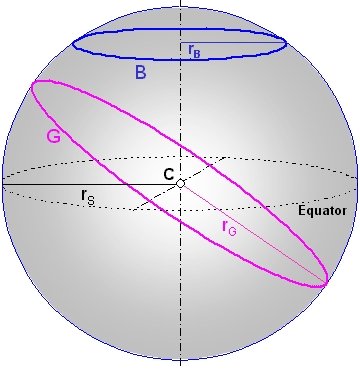
- A great circle divides the surface of a sphere in two equal
parts.
- A great circle is the largest circle that fits on the sphere.
- If you keep going straight across a sphere then you go along a
great circle.
- A great circle has the same center C as the sphere that it lies
on.
- The shortest route between two points, measured across the sphere,
is part of a great circle
All meridians are great circles. Latitude circles other than the
equator (for example circle B in the picture) are not great circles,
for example because they are smaller than the equator, which is a
great circle.
A great circle provides the shortest route if you travel at a fixed
speed compared to the ground, and also (approximately) if your speed,
though not fixed, is always much smaller than the rotation speed of
the sphere at its equator. This does not hold, for example, for
things that orbit around the Earth outside the atmosphere.
2. A Great Circle Through Two Known Points
Suppose that you want to draw the shortest route on a map between a
city P₁ and a far-away other city P₂, and you know the geographical
longitude and latitude of both cities. Then, you can calculate the
coordinates of points on that route as follows:
- Call the polar coordinates (longitude and latitude) of the first
city \( l_1 \) and \( b_1 \), and those of the second city \( l_2 \)
and \( b_2 \).
Fig. 2: Illustration of Transformation from Polar to Cartesian Coordinates
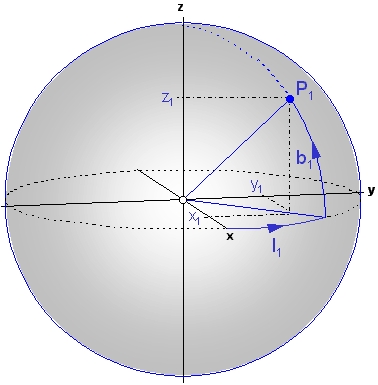
\begin{align}
x_1 & = \cos l_1 \cos b_1 \label{eq:naarcartesisch}
\\ y_1 & = \sin l_1 \cos b_1
\\ z_1 & = \sin b_1
\end{align}
and similarly for the second city P₂.
Fig. 3: Illustration of the Angular Distance Between P₁ and P₂
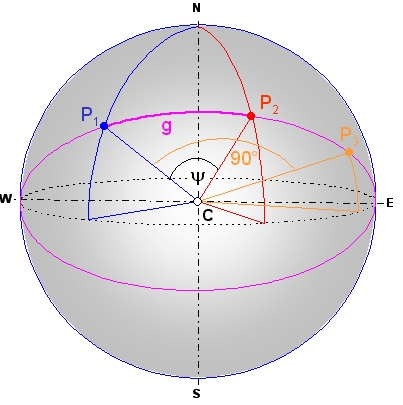
\begin{equation} ψ = \arccos(x_1 x_2 + y_1 y_2 + z_1 z_2)
\end{equation}
-
Calculate the coordinates of the point P₃ on the great circle that is
90° from the first city P₁ in the direction of the second city P₂ (see
Figure 3):
\begin{equation} x_3 = \frac{x_2 - x_1 \cos ψ}{\sin ψ}
\label{eq:punt3} \end{equation}
and similarly with \( y \) or \( z \) in stead of \( x \).
-
The cartesian coordinates of the points of the great circle are then,
as a function of the angular distance \( φ \) (phi) from the first
city:
\begin{equation} x = x_1 \cos φ + x_3 \sin φ \label{eq:positie}
\end{equation}
and similarly with \( y \) or \( z \) in stead of \( x \). If \( φ =
0 \), then you are in the first city. If \( φ = ψ \), then you are in
the second city.
-
You can now translate the cartesian coordinates \( x \), \( y \), \( z
\) to polar coordinates \( l \), \( b \):
\begin{align}
b & = \arcsin(z) \label{eq:naarpolair}
\\ l & = \arctan(y,x)
\end{align}
The \( \arctan(y,x) \) with two arguments means that you must make
sure that the answer is in the right quadrant. The correct answer is
either \( \arctan\left( \frac{y}{x} \right) \), or \( \arctan\left(
\frac{y}{x} \right) + 180° \), and (in this case) you must select the
solution that has \( x \) for its cosine and \( y \) for its sine
(with the correct signs).
Many computer languages and computer calculation programs have a
two-argument version of the arc tangent function, and many calculators
have a translation function from cartesian to polar coordinates that
you can use for this.
Fig. 4: Great Circle Through Amsterdam and San
Francisco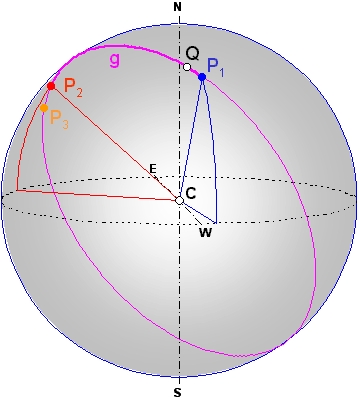
example (Figure
4):
Which point lies 1000 km from Amsterdam (P₁, 52°22' North, 4°54' East)
on the shortest route to San Francisco (P₂, 37°46' North, 122°25'
West), assuming that the
Earth is a sphere with a radius of 6378 km?
The distance per
degree across the sphere is equal to the radius times
\( π/180 = 0.017453292 \), so on Earth this is 111.317 km per degree.
We find:
- \( l_1 = 4.9° \); \( b_1 = 52.37° \); \( l_2 = −122.42° \); \( b_2
= 37.77° \)
- \( x_1 = 0.6083285 \); \( y_1 = 0.05215215 \); \( z_1 = 0.7919701
\); \( x_2 = −0.423791 \); \( y_2 = −0.6672729 \); \( z_2 = 0.6124933
\)
- \( ψ = 78.90289° \), so San Francisco is \( 78.90289 × 111.317 =
8783 \) km from Amsterdam.
- \( x_3 = −0.5511833 \); \( y_3 = −0.6902162 \); \( z_3 = 0.4688268
\). This corresponds to \( b_3 = 27.95817° \); \( l_3 = −128.6097°
\), which is a location in the Eastern Pacific Ocean, to the West of
Mexico.
- 1000 km corresponds to \( 1000/111.317 = 8.98335 \) degrees, so \(
φ = 8.98335° \). Then \( x = 0.5148008 \); \( y = −0.05626304 \); \(
z = 0.8554617 \).
- \( b = 58.81077° \); \( l = −6.237153° \). This is a location
just to the North of Scotland.
3. Alternative
There is an alternative for formula \ref{eq:positie}, which does not
require the calculation of the position of point 3:
\begin{equation} x = \frac{x_1 \sin(ψ - φ) + x_2 \sin φ}{\sin ψ}
\end{equation}
and similarly with \( y \) or \( z \) instead of \( x \). However,
point 3 is necessary if you want to know other things about the great
circle, as you'll see below.
4. A Great Circle in a Certain Direction Through a Known Point
Suppose you want to know where you go if you start from a particular
town in a particular direction and keep going straight. We assume
that you travel at a speed that is much smaller than the rotation
speed of the Earth along the equator. You'll then travel along a
great circle. You can calculate the coordinates of points along the
route as follows:
- Call the polar coordinates (longitude and latitude) of the city \(
l_1 \) and \( b_1 \), and the direction in which you start \( γ \),
measured from south to west (so south = 0°, west = 90°, north = 180°,
east = 270°).
- Translate the polar coordinates of the city to the corresponding
cartesian coordinates \( x_1 \), \( y_1 \), \( z_1 \) according to
formulas \ref{eq:naarcartesisch}ff.
- Calculate the cartesian coordinates \( x_\text{zuid} \), \(
y_\text{zuid} \), \( z_\text{zuid} \) of the corresponding south point
with \( l_\text{south} = l_1 \); \( b_\text{south} = b_1 - 90° \) if
\( b_1 \) is positive (i.e., in the Northern hemisphere), and \(
l_\text{south} = l_1 + 180° \); \( b_\text{south} = −90° - b_1 \) if
\( b_1 \) is negative (i.e., in the southern hemisphere).
- Calculate the cartesian coordinates \( x_\text{west} \), \(
y_\text{west} \), \( z_\text{west} \) of the corresponding west point
with \( l_\text{west} = l_1 - 90° \); \( b_\text{west} = 0 \).
-
Calculate the cartesian coordinates \( x_3 \), \( y_3 \), \( z_3 \) of
the great circle point at 90° from the city:
\begin{equation} x_3 = x_\text{south} \cos γ + x_\text{west} \sin γ
\end{equation}
and similarly with \( y \) or \( z \) instead of \( x \).
- Now use formulas \ref{eq:positie} and \ref{eq:naarpolair}ff to
calculate the desired cartesian and polar coordinates.
Suppose you start from Amsterdam (52°22' north,
4°54' east) by going straight to the east, and you keep going
straight. If you keep this up for 1000 km, then where are you?
- \( l_1 = 4.9° \); \( b_1 = 52.37° \); \( γ = 270° \)
- \( x_1 = 0.6083285 \); \( y_1 = 0.05215215 \); \( z_1 = 0.7919701
\)
- \( x_\text{south} = 0.7890756 \); \( y_\text{south} = 0.06764765
\); \( z_\text{south} = −0.6105599 \)
- \( x_\text{west} = 0.08541692 \); \( y_\text{west} = −0.9963453
\); \( z_\text{west} = 0 \)
- \( x_3 = −0.08541692 \); \( y_3 = 0.9963453 \); \( z_3 = 0.7919701
\), so in this case each cartesian coordinate of point 3 is the
opposite of the corresponding coordinate of the west point, which was
to be expected because we start out going straight to the east.
1000 km corresponds to 8.98335°, dus \( φ = 8.98335° \). With that,
we find \( x = 0.587529 \); \( y = 0.2070892 \); \( z = 0.7822556 \),
en dan \( b = 51.46756° \); \( l = 19.41627° \). This is a location
in the middle of Poland.
5. The Northernmost and Southernmost Point of a Great Circle
Fig. 5: Northernmost and Southernmost Point on a Great Circle
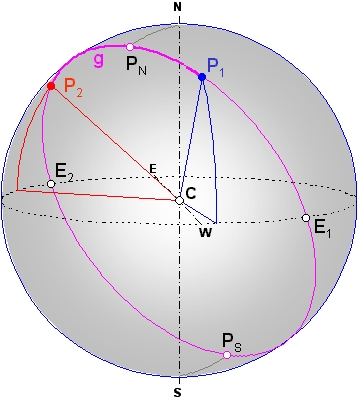
Calculate the angular distance of the first city P₁ from the first
special (northernmost or southernmost) point:
\begin{equation} φ_1 = \arctan\left( \frac{z_3}{z_1} \right)
\end{equation}
The angular distance of the second special point is 180° greater (or
less, that is the same thing on a circle):
\begin{equation} φ_2 = φ_1 + 180° \end{equation}
You can then use formula \ref{eq:positie} to calculate the
corresponding cartesian coordinates, and then formula
\ref{eq:naarpolair}ff to calculate the polar coordinates. It is not
necessary to calculate the coordinates of the second special point,
because it is at the exact opposite side of the planet from the first
one, so its cartesian coordinates and its latitude are equal to those
of the first point, times −1, and its longitude is 180° around the
planet from the first special point.
For the great circle that passes through
Amsterdam and San Francisco, we find \( φ_1 = 30.62449° \); \( φ_2 =
210.62449° \). The corresponding cartesian coordinates are \( x =
−0.2427036 \); \( y = 0.3067243 \); \( z = −0.9203343 \) for \( φ_1
\), and \( x = 0.2427036 \); \( y = −0.3067243 \); \( z = 0.9203343 \)
for \( φ_2 \). The corresponding polar coordinates are \( b = 66.975°
\); \( l = −51.64627° \) for \( φ_1 \) and \( b = −66.975° \); \( l =
128.3537° \) for \( φ_2 \).
6. The Equator Points of a Great Circle
Every great circle except for the equator intersects the equator in
two points, called E_1 and E_2 in Figure 5. The longitudes of
those points are 90° to the east and west of the northernmost and
southernmost points of the great circle, of which the calculation is
explained above.
For example, the great circle through Amsterdam
and San
Francisco crosses the equator at longitudes 38.3537° and
−141.64627°, in Kenya and the Pacific Ocean, respectively.
7. Great Circle on a Topographic Map
Fig. 6: Great Circle on a Map
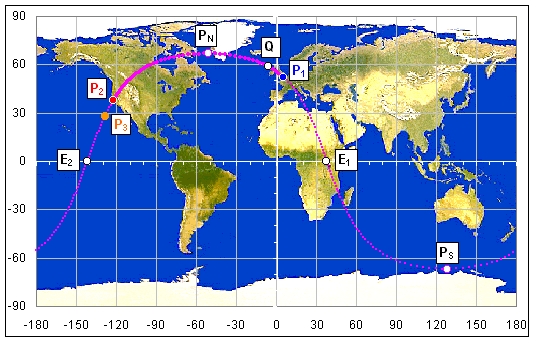
It is impossible to make a map of the world on which all great circles
run straight, but it is possible to make a map on which some great
circles run straight, for example all great circles through a single
point. In Figure 6, all great circles through the North Pole
and South Pole run straight: Those are the meridians. The equator is
a great circle and it, too, runs straight through that map.
![[AA]](../../pic/pr.gif "AA")
languages: [en] [nl]
http://aa.quae.nl/en/reken/grootcirkel.html;
Last updated: 2016−02−07
![[Dictionary]](../../pic/glossary.gif "Dictionary")
![[AnswerBook]](../../pic/book.gif "AnswerBook")
![[Universe Family Tree]](../../pic/tree.gif "Universe Family Tree")
![[Science]](../../pic/science.gif "Science")
![[Starry Sky]](../../pic/sterren.gif "Starry Sky")
![[Planet Positions]](../../pic/planeet.gif "Planet Positions")
![[Calculate]](../../pic/reken.gif "Calculate")
![[Colophon]](../../pic/copybtn.gif "Colophon")